In modern glass processing, manipulators are the critical link between high-speed production and in-plant safety. Unlike ordinary lifting equipment, the manipulator integrates all the handling controls and the vertical lifting of the crane into a single ergonomic console, allowing a single operator to manage heavy, large-format glass with precision and reduced physical effort. Vertical lifting is available either in an electric version via a hoist or in a pneumatic version.
Whether unloading from an insulating-glass line or feeding a horizontal CNC, these systems are conceived to improve handling and operator safety.
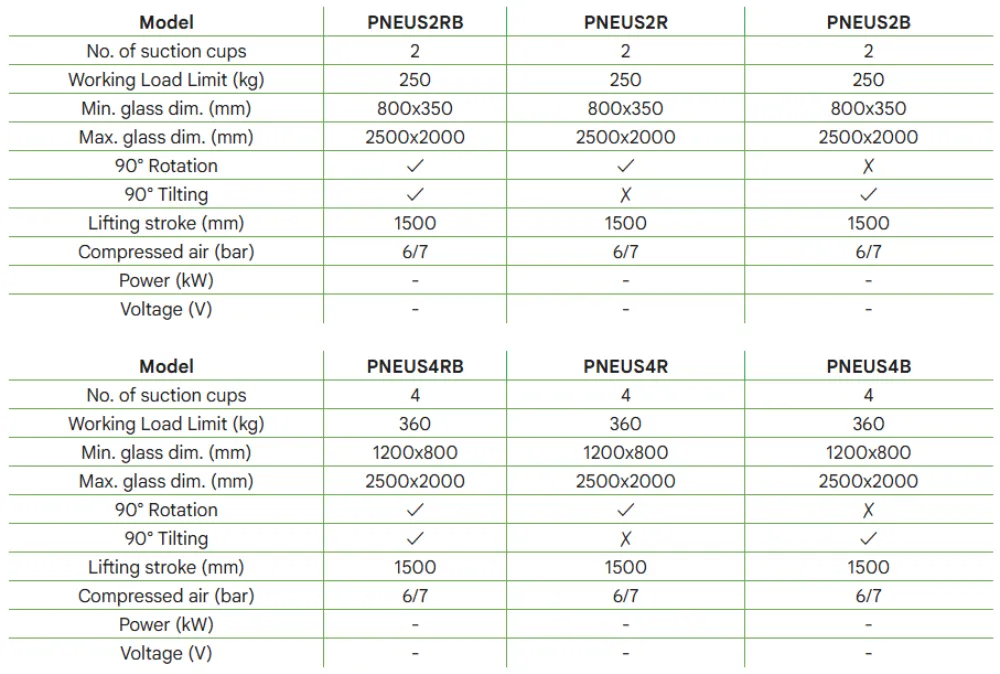
PNEUS pneumatic manipulators are vacuum lifting devices that run entirely on compressed air.
Their distinctive feature is that all main functions – lifting, loading/unloading, rotation and tilting – are controlled directly from the control console.
This allows the operator to manage the entire handling cycle simply, quickly and safely, minimising manual movements and improving work ergonomics.
These units use a pneumatic cylinder for lifting, giving greater stability and ‘rigidity’ than chain systems with an electric hoist.

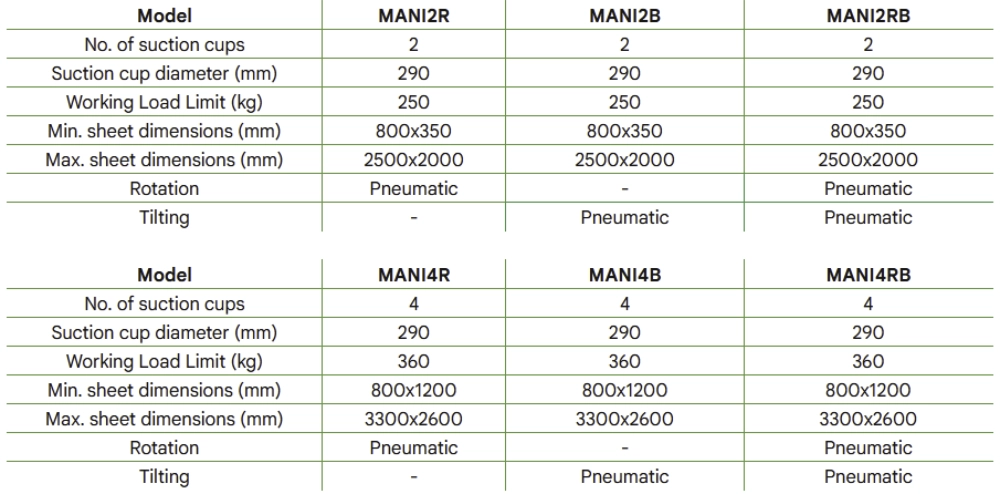
The MANI series manipulator has pneumatic vacuum, rotation and tilting functions, but lifting is handled by an electric chain hoist. The up/down controls are located directly on the manipulator’s control console. The operator manages all functions – lifting, rotation, tilting, loading and unloading – from the control console.

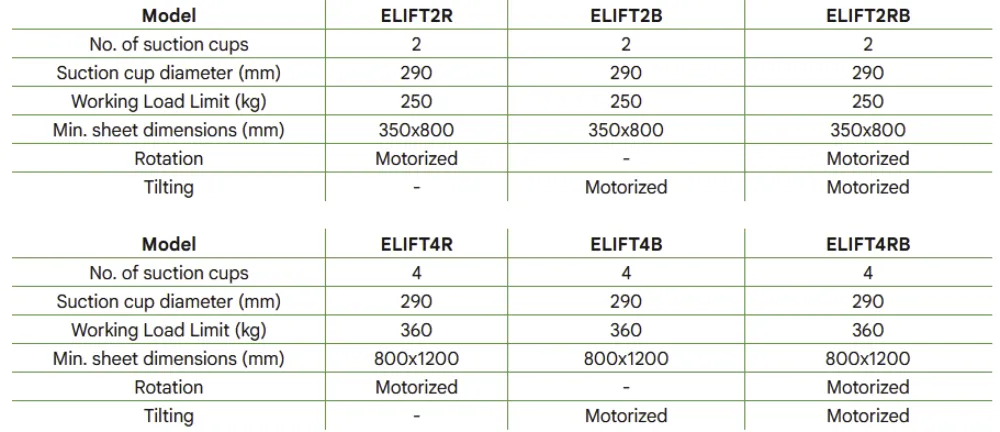
In all situations where compressed air is not available, or for heavy loads, our fully electric glass manipulators are the ideal solution.
All units are fully CE certified and designed in full compliance with current safety directives, ensuring long-term reliability and operational risk reduction.
The ergonomic console centralises all functions: lifting, tilting, vacuum activation and quick release. This intuitive interface reduces cycle times, improves safety and reduces physical effort for production staff.
Pneumatic or motorised rotation and tilting ensure smooth, controlled movement Operators manage complex movements directly from the console, eliminating physical strain and ensuring precise load orientation.
In the pneumatic version, the use of a cylinder eliminates the 'pendulum effect' typical of rope or chain hoists. This ensures an immediate response from the crane arm.
Integrated safety devices and dual-button release systems prevent accidental unloading. The quick release prevents the load from being dragged by the suction-cup effect.


The MANI series represents a specialized evolution in glass handling, designed specifically for integration with insulating glass lines and straight edging machines. Unlike basic lifters, these manipulators feature a centralized operating console that can integrate crane hoist commands (Up/Down). This consolidation of controls allows a single operator to manage both the vacuum engagement and the vertical displacement, significantly increasing throughput while reducing ergonomic strain.
Safety is a proactive approach in the Schiavo philosophy. The MANI series is equipped with a safety system that prevents the accidental release of the load if it is not resting on a surface. This eliminates the risk of human error during high-frequency production cycles.
Operating Range: Standard pads function reliably between -10°C and 40°C (32-104°F).
The choice depends on the required precision and available utilities:
Pneumatic (PNEUS Series): Utilizes compressed air (6/7 bar) for 90° tilting. Ideal for rapid, repetitive movements where air lines are readily available.
Electric/Motorized (ELIFT Series): Features motorized 90° tilting or 360° rotation via gearmotors and inverters. This provides smoother, more controlled movement for heavier loads (up to 540 kg) and is essential when compressed air is not the primary power source.
Reliability in high-cadence glass handling is a product of rigorous preventative maintenance. Schiavo aligns its recommendations with international safety standards to ensure the integrity of the lifting cycle:
Daily/Shift-Start Inspections: Operators must perform visual checks on suction pads, vacuum pipelines, and vacuum gauges before every shift to identify any signs of wear or to verify correct operation.
Frequent Operational Checks: Every 20 to 40 hours of operation, a more detailed verification of the warning systems (acoustic/luminous) and pad seals is required.
Periodic Certified Inspections: Comprehensive technical audits should be conducted every year. These are essential for evaluating vacuum pump efficiency and vacuum-circuit tightness.
There is no single answer. Both may be the right solution, but the application and specific requirement must be analysed. The PNEUS series offers more rigid, jerk-free movement of the crane arm, but the lifting cylinder stroke is limited. The MANI series allows long lifting strokes and can also be connected to electric hoists already in the plant (if compatible). However, the chain is flexible and rotating the crane arm is harder, as it is subject to the arm's inertia.
Schiavo maintains a strategic inventory of standard components to support rapid deployment.
In-Stock Units: Available for immediate dispatch following final testing.
Bespoke Construction: If a unit must be engineered to specific requirements, the standard lead time is approximately 4 working weeks. This timeframe ensures that every machine undergoes our mandatory "Italian Technology" quality control protocol before leaving our facility.
At Schiavo, we believe that the best industrial solutions are not simply sold, they are built through collaboration. Our team of designers and technicians is ready to work alongside you to find the perfect balance between your operational vision and our engineering solutions.
Whether you need to optimize a single process or design a complete custom line, we are here to listen. Share a few details about your project below, and let’s explore together how our Made in Italy technology can move your business forward.


